We're a small team that builds tools for people who are drowning in data, juggling too many interfaces, and wishing their infrastructure would just explain itself.
So we built a platform where AI agents talk to your systems, make sense of the noise, and actually do useful things. Then we open-sourced the pieces, because that's what you do.
Poke around. Break things. Build on top of what we've done.
How it works — the 30-second architecture tour
What's here — find the stuff you care about
Lab Notes — the latest from our lab notebook
Everything in Strike48 is built around hubs and connectors.
A connector is a standalone process that does one thing well — scan a network, manage Kubernetes clusters, run a C2 operation. It connects to a hub and waits for instructions.
A hub coordinates connectors. It's where you write workflows, chat with AI agents, and see what's happening across your infrastructure. Ask an agent "what's listening on this network?" and it knows to reach out to the right connector, assemble the results, and give you an answer.
The result: each tool stays small and focused, but together they form a platform where AI agents can actually do things in the real world.
AI-assisted engagements, network recon, built-in C2, and reporting that doesn't make you want to cry. From planning to deliverable.
Kubernetes cluster management and a unified desktop shell that puts all your tools in one window. Because alt-tabbing is not a workflow.
Autonomous agents, RAG-powered knowledge bases, and visual workflows. Point them at your data and let them figure it out.
Rust SDK, gRPC APIs, and a connector architecture that lets you plug anything into the platform. Your tool, our plumbing.
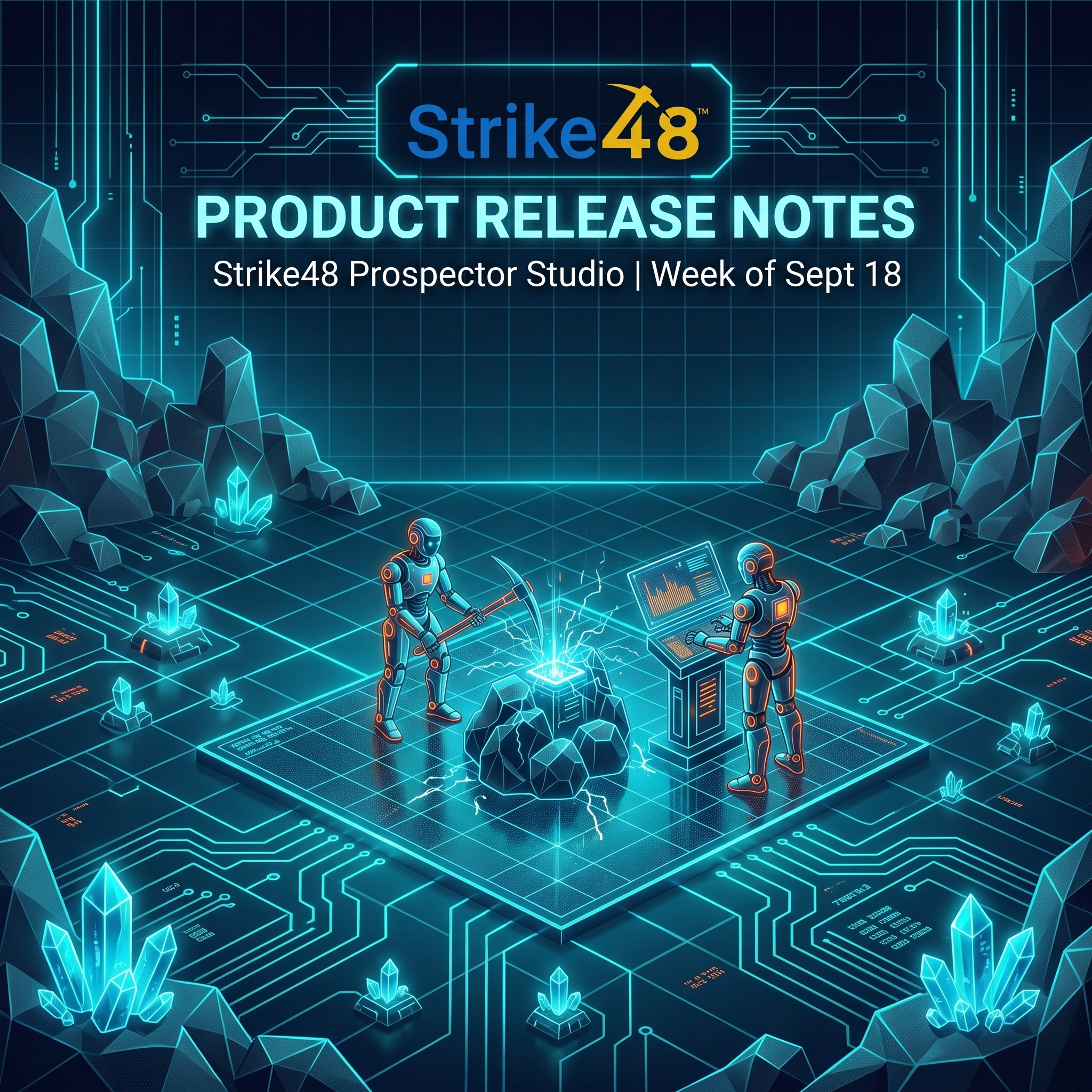
A bug-fix-only release across StrikeKit, Code Mode, Strike48, and Webhooks.
 Strike48
·
Strike48
·
Four new MCP integrations join the library, alongside fixes and improvements to Devo SIEM, RecordedFuture, Azure Sentinel, and more.
Strike48
·
A bug-fix-only release across StrikeKit, ASOC v2, Gateways, and Personas.
Strike48
·
Prospector Studio now supports 97 Bedrock-backed AI models across three usage tiers, so agents and workflows can be tuned to the right model for every task.
Strike48
·
Prospector Studio Release 2026.07.24 ships Code Mode — a programmable JavaScript execution environment for tool orchestration — plus a large round of platform reliability and stability work.
Strike48
·

Prospector Studio Release 2026.07.13 ships two major features: a redesigned MSSP management layer and a completely overhauled Agentic SOC (ASOC v2) with autonomous L1/L2 triage.
Strike48
·
Pick a path and start exploring. Or just read the Lab Notes — we won't judge.